
Evaluating online tools that teach us about fake news helps us see what works best. Two popular tools try to solve this problem in very different ways: RumorGuard, which checks claims directly, and Bad News, a game that lets you play the role of a fake-news creator.
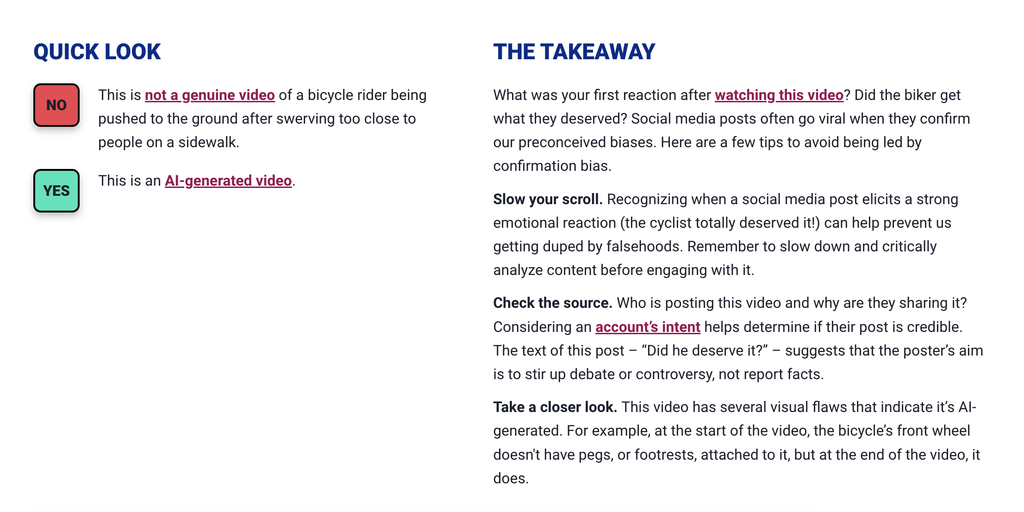
RumorGuard is a website made by the News Literacy Project that analyzes viral internet rumors. Instead of just saying a post is real or fake, it teaches people how to check claims themselves using five clear rules: Source, Evidence, Context, Reasoning, and Authenticity. It walks users through real posts and shows them basic trick-spotting steps, like checking where photos really came from. RumorGuard works well because it gives people simple skills they can use every day. Its main drawback is that it can only react to rumors that are already viral, and it usually attracts people who are already careful about what they read.
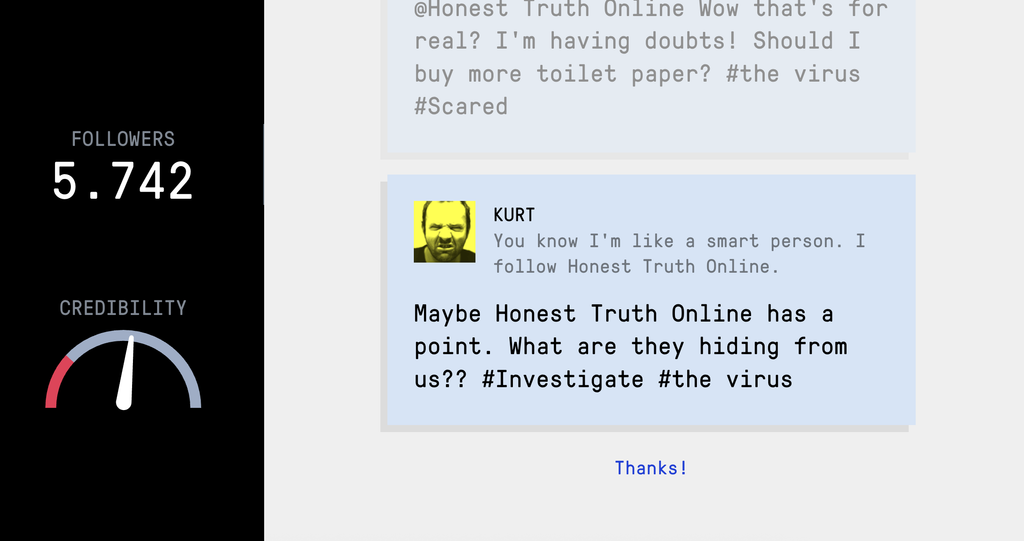
Bad News is a free web game created by researchers at Cambridge University. In the game, you act as an online manipulator trying to gain as many followers as possible by spreading fear, conspiracy theories, and anger. By letting you try out these tricks in a safe game, it acts like a “vaccine” against online deceit. Studies from Cambridge show that playing the game helps people spot real online tricks much better, no matter their political beliefs. The main downside is that the game choices are somewhat exaggerated, while real fake news can be much harder to spot.

Overall, interactive games and hands-on tools are much better at teaching than boring lectures or articles because learning by doing makes the lessons stick. Playing as the “bad guy” helps you see why people post outrage and clickbait in the first place. Even so, these tools cannot fix everything because social media apps are still built to spread drama, and people often believe what they want to believe. Using games like Bad News before you see fake news, and site tools like RumorGuard when a rumor is spreading, gives us a great two-step defense.
Sources:
Basol, M., Roozenbeek, J., & van der Linden, S. (2020). Good news about Bad News: Gamified inoculation boosts confidence and cognitive immunity against fake news. Journal of Cognition, 3(1), Article 2. https://doi.org/10.5334/joc.91
DROG, & Social Decision Making Lab, University of Cambridge. (n.d.). Bad News [Video game]. https://www.getbadnews.com
News Literacy Project. (n.d.). RumorGuard: Real rumors, real facts, real learning. https://www.rumorguard.org
News Literacy Project. (2022). The five factors: Learn to evaluate credibility. https://newslit.org/news-and-research/rumorguard-5-factors/
Roozenbeek, J., & van der Linden, S. (2019). Fake news game confers psychological resistance against online misinformation. Palgrave Communications, 5, Article 65. https://doi.org/10.1057/s41599-019-0279-9
University of Cambridge. (2019, June 25). Online game helps players to spot fake news. https://www.cam.ac.uk/research/news/game-helps-players-spot-fake-news